China High Strength Lifting Wire Rope 6x36WS+IWRC Galvanized Steel Wire Rope Suppliers, Factories

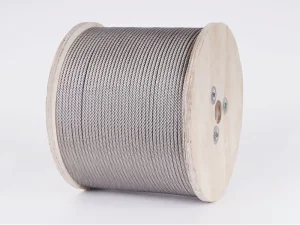
Drawing galvanized standard steel wire rope for a wide range of applications such as cargo wheels, hoisting, luffing, mooring, hauling, anchoring, etc. It is also suitable for making wire rope slings for lifting operations.

The best combination of flexibility and wear resistance. Parallel laying structure, long service life.

The structure complies with EN 12385 standard.

Product Description

Hoisting Steel Wire Rope

Lifting wire rope is a vital load-bearing and traction component in lifting machinery. Its main function is to lift, pull, tighten, and carry heavy objects across various industrial sectors.

Features

Compaction Process
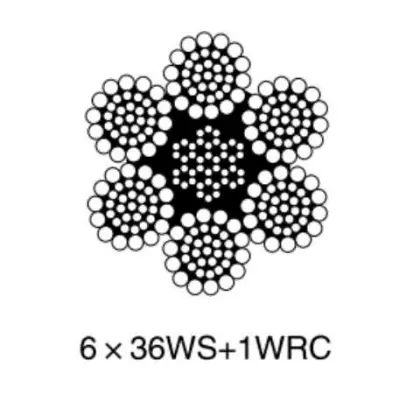
Rope Core: IWRC (Independent Wire Rope Core)
Strength Grade: 1770Mpa / 1960Mpa / 2160Mpa
Twist Type: Same direction or alternating twist
Twist Direction: RH (Right Hand) or LH (Left Hand)
Surface Condition: Smooth (Bright) or Galvanized

Main Advantages

Applicable and highly stable wire rope structure
Fully lubricated during the production process for durability
High resistance to fatigue and wear

Applications

Engineering Cranes
Port Cranes
Industrial Cranes
Offshore Cranes
Winches
Drilling Platforms

Wire Rope Scrapping Standards

For safety, a wire rope should be scrapped if any of the following conditions are met:

  • Broken wires in one twist exceed 10% of the total wires.
  • Outer wire wear exceeds 40% of the original diameter.
  • For hazardous goods lifting, standards are twice as strict.
  • The wire rope diameter is reduced by 7% or more.
  • Fiber core exposure or cage-like deformation.

Key Points for Replacement

1. Specifications: Always use qualified original design models, diameters, and nominal tensile strength. Using lower specifications will drastically reduce service life.

2. Quality Assurance: Never use wire ropes without a certificate of conformity. If changing diameters, ensure breaking force matches original requirements within strict tolerance (max 1mm to 1.5mm difference).

3. Handling: Avoid knotting during winding. Knotted ropes are prone to premature wear and breakage. Connection of two separate ropes in a lifting mechanism is strictly forbidden.

6x36WS+IWRC Technical Specifications

Diameter (mm) Approx. Weight (kg/100m) EN12385-4 Min. Breaking Load (KN) DIN3064 Min. Breaking Load (KN) GB/T9944 GB/T8918 Min. Breaking Load (KN)
1570Mpa 1770Mpa 1960Mpa 1570Mpa 1770Mpa Load (KN) 1570Mpa 1770Mpa
6.015.3020.1022.7025.1020.1022.7022.7020.1022.70
8.027.2035.8040.3044.7035.8040.3040.3035.8040.30
10.042.5055.9063.0069.8055.9063.0055.9055.9063.00
12.061.2080.5090.70-80.6089.9080.6080.4090.70
14.083.30109.50124.00-109.00124.00109.00109.00123.00
16.0108.80143.10161.00-143.00161.00143.00143.00161.00
18.0137.70181.00--181.00204.00181.00181.00-
20.0170.00224.00--221.00252.00221.00223.00-
22.0205.70271.00--271.00304.00271.00270.00-
24.0244.80322.00--322.00363.00322.00321.00-
26.0287.30378.00--378.00425.00378.00377.00-
28.0333.20438.00--438.00493.00438.00438.00-

Frequently Asked Questions

What are the primary applications for the 6x36 WS wire rope?
The 6x36 WS (Warrington-Seale) construction is highly flexible and durable, making it ideal for engineering cranes, port cranes, offshore platforms, and heavy-duty winches.
What does IWRC mean in wire rope specifications?
IWRC stands for Independent Wire Rope Core. This means the core of the rope is actually a smaller wire rope itself, which provides higher strength and better resistance to crushing compared to fiber cores.
When should I replace my hoisting wire rope?
You should replace the rope if broken wires exceed 10% of the total wires in one twist, if diameter reduction reaches 7%, or if outer wire wear exceeds 40% of the original diameter.
How do I choose between galvanized and smooth wire rope?
Galvanized wire ropes offer superior corrosion resistance, making them suitable for marine and offshore environments. Smooth (bright) ropes are typically used in indoor or well-lubricated industrial applications.
Can I replace a wire rope with a different diameter?
It is recommended to use the original design diameter. If a change is necessary, the diameter difference should not exceed 1mm (for ropes <20mm) or 1.5mm (for ropes >20mm), and the breaking force must be equal or higher.
Why is lubrication important for lifting wire ropes?
Lubrication reduces internal friction between individual wires and strands and protects against corrosion, significantly extending the service life and safety of the rope.

Related Products